Pressing
Pressing, compacting and forming are essential processes in industry and craft, using manual, pneumatic or hydropneumatic presses to manipulate a variety of materials. These techniques enable powders to be given a uniform shape, springs to be compressed or soap to be molded, for example.
Thanks to their advanced technology, EMG presses provide precise pressure for a variety of applications, from the laboratory to industrial production. Discover how these machines efficiently transform materials into high-precision finished products.
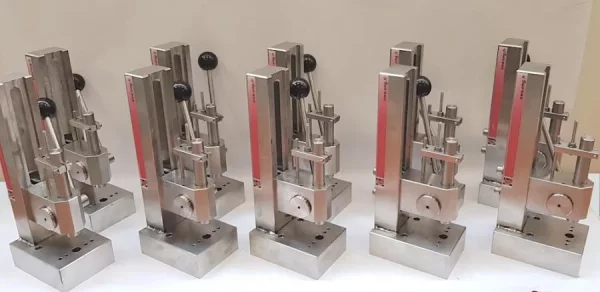
Pressing consists in compressing one or more elements together, as if gluing several parts together, with or without maintaining compression over a given time. Pressing can also be used to modify the elastic potential energy of a system, in order to achieve assemblies under stress, as when compressing a spring in a specific assembly, for example.
Pressing can also be used to create a defined shape (using a mold) by compressing a specific set of materials (organic, mineral, etc.) with sufficient power. This type of use comes into play for applications such as shaping soaps, medicinal tablets, clay or ceramic buttons for decoration, quicklime or sawdust, for example.
Pressing also enables elements to be compacted (e.g. compacting powder, shavings, etc.).
Forming and molding a material using a press
Cold forming or molding of a material is a process in which the material is given a new shape using molds. Manual, pneumatic and hydropneumatic presses can be used to form materials. This process is often used to press soft materials, such as powders, powders or fibers.
A wide variety of parts can be manufactured using this process. While a manual press can be used to produce small runs of compressed powders, a pneumatic or hydropneumatic press enables laboratories to produce large runs. Also, in the medical and orthopedic fields, foams can be compressed to make insoles and protectors for equipment.
Stages in the pressing/molding process
Whether the process uses a manual, pneumatic or hydropneumatic press, the four main stages are the same:
- Placing the material: The material to be pressed (powder, paste, powdery material, etc.) is placed in a mold or on a die,
- Press actuation: The operator actuates the press by means of a lever or control, generating direct pressure on the material. The pressure generated depends on the machine used,
- Product formation: Under pressure, the material is compacted, formed or molded to adopt the desired shape and size.
- Product removal: Once pressing is complete, the finished product is removed from the mold.
EMG compression presses: manual, pneumatic and hydropneumatic for high output
EMG presses are distinguished by their ability to deliver high output thanks to manual, pneumatic and hydropneumatic technologies. They are designed to meet both industrial and craft needs. Each type of press offers specific advantages, guaranteeing efficient and precise production, adapted to each application for pressing as well as stamping, riveting, bending or cutting.
To help you choose the press you need for your application, we suggest you call on our technical and testing center for sample production. Our experts will analyze your needs and then produce samples to determine the precise machine required.